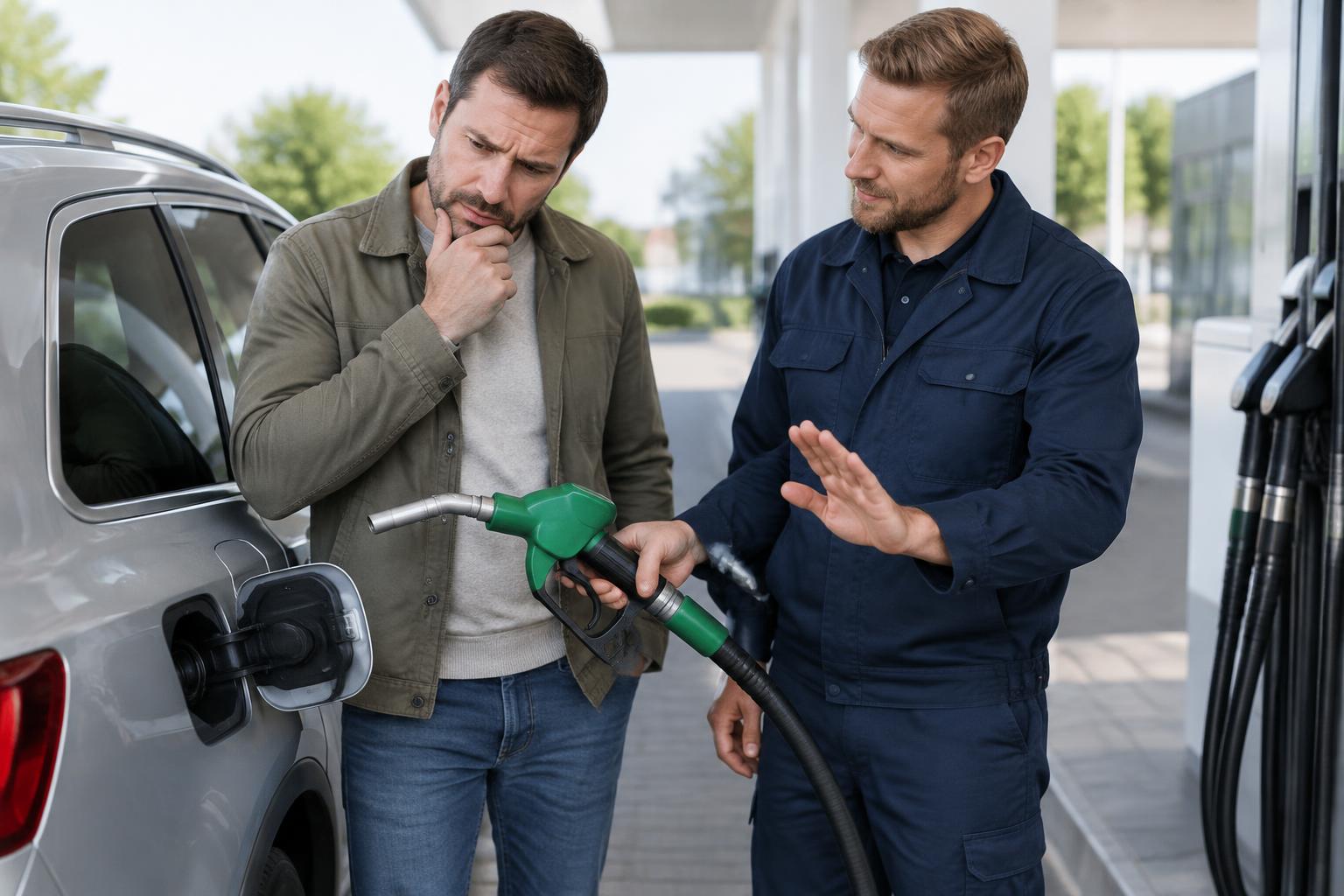
First aid: what to do now
As soon as you notice the mistake, stop filling. Then: do not switch on the ignition, do not start the engine. The steps intended for your car are in the owner's manual. The quick check shows what matters in each case.
Quick check: what to do
What happened?
Choose what happened.
If in doubt: call a garage or breakdown service. Your car's owner's manual is what counts.
Petrol in a diesel: the most expensive mistake
Petrol removes the lubricating film that diesel leaves in the injection system. The high-pressure pump then often fails completely and metal chips get into the fuel system – at that point, a repair is unavoidable.
So: do not open the driver's door – on some models, that already starts the fuel pump – and leave the ignition off. If neither the engine nor the ignition was on, draining the mixture may be enough. If the engine ran, the injection system, high-pressure pump, injectors, lines and tank may need replacing. According to the ADAC, that costs several thousand euros.
Older diesels with a swirl chamber or pre-chamber, i.e. without direct injection, get off more lightly: they usually tolerate a few litres of petrol.
Diesel in a petrol car
The reverse mistake is possible with many current petrol cars too, because they often lack the protection older models had. Here too: do not open the driver's door, do not start the engine.
If you only notice the mistake while driving, stop as soon as possible and switch off the engine. Depending on the engine and the amount, you may be able to drive on carefully and top up with the right fuel, or the tank has to be drained. Damage to the injection system and exhaust after-treatment cannot be ruled out.
Mixed up E10, Super and Super Plus
Super instead of Super Plus: no draining needed – the knock sensor adjusts the engine. Very old cars, often without a catalytic converter and knock sensor, should not be pushed – no top speed, no hill climbs, no trailer – and should then be filled up with the right grade.
Super Plus instead of Super or E10: harmless, just drive on. You have only paid too much – according to the ADAC, Super Plus does not increase power.
E10 in a car without E10 approval: most cars are approved for E10 – if in doubt, ask the manufacturer. If your car is not approved, even a single mistaken fill can cause damage. According to ADAC experts, it may be enough to top up straight away with low-ethanol fuel, ideally Super Plus. If the tank is filled to the brim with E10, draining may be necessary depending on the manufacturer. More on the grades: E10 or E5?
AdBlue in the diesel tank
AdBlue easily ends up in the diesel tank when there is no misfuelling protection – for example when topping up from simple 5 or 10 litre canisters. If the ignition was not yet on, an intensive tank cleaning is usually enough.
If the ignition was on, AdBlue can reach the injection system. Then, besides tank cleaning, pumps, lines, filters, nozzles or injectors have to be replaced; the costs are similar to those for petrol in a diesel.
Diesel in the AdBlue tank, on the other hand, is unlikely, because the nozzles do not fit: the AdBlue filler neck measures 19.75 mm, the diesel nozzle 25 mm and the petrol nozzle 21 mm.
Who pays?
As a rule, whoever put in the wrong fuel pays. Motor insurance usually does not pay here.
How to avoid it
- Spare fuel cans are especially risky: their spouts fit both petrol and diesel filler necks. If in doubt, use a different can.
- Read the owner's manual and choose the grade at the pump consciously.
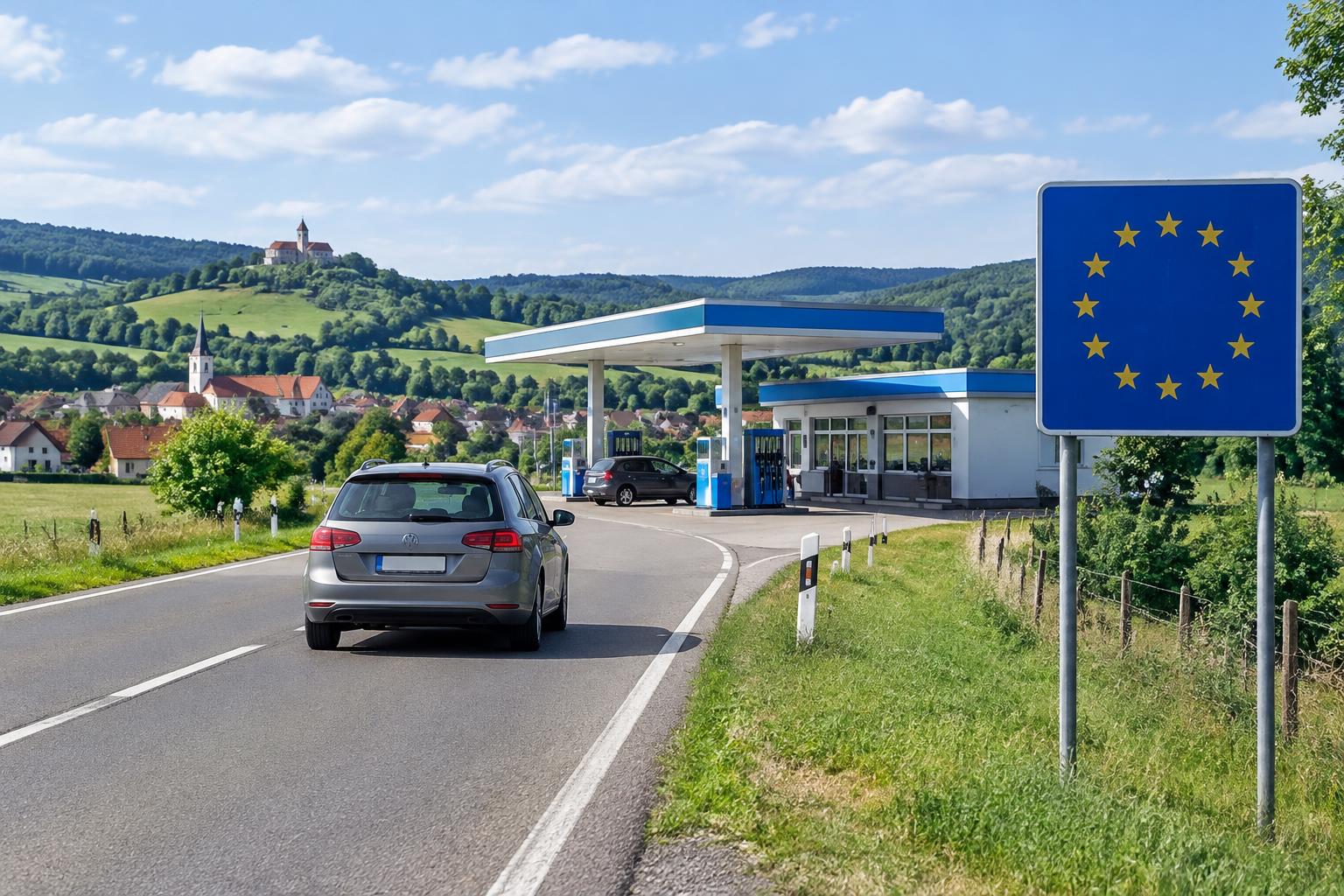
- Abroad, the uniform EU-wide fuel labels help.
- In the German registration certificate (Zulassungsbescheinigung Teil I), field P.3 states the fuel type.
The EU labels on pumps and filler caps
Since October 2018, pumps, nozzles and new cars in the EU have carried the same symbols (standard EN 16942). The shape shows the type of fuel, the lettering the grade.
Circle: petrol
- E5 – Super petrol with up to 5% ethanol
- E10 – Super petrol with up to 10% ethanol
- E85 – up to 85% ethanol, for flex-fuel cars only
Square: diesel
- B7 – diesel with up to 7% biodiesel – standard diesel
- B10 – diesel with up to 10% biodiesel
- XTL – paraffinic diesel, for example HVO100
Diamond: gas and hydrogen
- H2 – hydrogen
- CNG – compressed natural gas
- LPG – autogas (liquefied petroleum gas)
- LNG – liquefied natural gas
XTL stands for paraffinic diesel such as HVO100 – more in the guide HVO100. You can find petrol stations near you via the city overview.
Frequently asked questions about using the wrong fuel
What should I do if I put petrol in a diesel?
Stop filling straight away, do not switch on the ignition, do not start the engine and do not open the driver's door – on some models, that already starts the fuel pump. Then call a garage or breakdown service. If neither the engine nor the ignition was on, draining the mixture may be enough.
What happens if the engine ran with petrol in a diesel?
Petrol removes diesel's lubricating film, the high-pressure pump often fails completely and metal chips get into the fuel system. The injection system, high-pressure pump, injectors, lines and tank may need replacing – according to the ADAC, that costs several thousand euros.
What should I do if I put diesel in a petrol car?
Do not open the driver's door, do not start the engine. If you notice it while driving, stop as soon as possible and switch off the engine. Depending on the engine and the amount, driving on carefully and topping up with the right fuel may be enough, or the tank has to be drained.
Is Super instead of Super Plus a problem?
No, you do not need to drain the tank: the knock sensor adjusts the engine. Drive very old cars without a knock sensor gently until the next fill-up – no top speed, no hill climbs, no trailer. Super Plus instead of Super or E10 is harmless.
What should I do about AdBlue in the diesel tank?
Leave the ignition off and call a garage or breakdown service. If the ignition was not yet on, an intensive tank cleaning is usually enough. If it was on, AdBlue can reach the injection system; then pumps, lines, filters, nozzles or injectors have to be replaced as well.
Does insurance pay for misfuelling?
Usually not. As a rule, whoever put in the wrong fuel bears the costs; motor insurance usually does not pay here.
Sources
Last updated: